If you are from the UK or Western Europe, hearing “medical spa” probably makes you picture fluffy white bathrobes, cucumber water, and a relaxing weekend massage. In Slovakia, post-operative spa rehabilitation is a completely different beast.
After a total hip replacement, the healthcare system sends you for a three-to-four-week stay in a historic spa town like Trenčianske Teplice—a legendary thermal valley tucked into western Slovakia. Here, you aren’t a luxury hotel guest; you are a pacoš (slang for patient) armed with a plastic wristband, a strict printed timetable of sulfur baths and water exercises, and a walking stick.
The crutches are in the corner; the cane has taken over. After my surgery in Bratislava—officially turning me into an Iron Man—and a few weeks of home exercises, it was time for this next milestone. The first week in a Slovak medical spa feels like stepping into an alternate space-time continuum. Here are the unfiltered fragments from my recovery diary.
Table 82/2 and Pajama Logistics
82/2. My table number and my seat number. I’m on the first shift, meaning breakfast is strictly 7:00 to 7:45 AM, lunch is just before noon, and dinner is shortly after five. Having a walking stick comes with one glorious perk: anyone with a cane is allowed into the dining hall ten minutes early to beat the stampede of hungry patients. I have a cane.
Our table sits right next to the breakfast buffet, giving me a front-row seat to human nature. An elderly gentleman in full pajamas just shuffled up to the hard-boiled eggs. Plop, one goes into his pocket. Plop, a second one… A local politician? I only raise an eyebrow when he starts stuffing two greasy sausages and two mini-packs of butter into the exact same pocket.
It’s not that the signs forbidding food removal from the dining hall are hard to read. Good grief, man, those pockets are going to reek…
On the bright side, I have wonderful tablemates. Sitting right next to me is a Catholic nun. She has a massive sweet tooth, so I happily donate my daily pastry to her. She puts up a brief token resistance—she’s a woman, after all—before caving in and polishing off the cake.
Eskulap, the Spring Courtyard, and Manor-House Classics
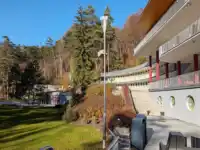
The Eskulap spa house has definitely seen better decades, yet for me, it was the ideal choice. It landed me a single room. Neighboring spa hotels like Krym or Pax are grand, sure, but I didn’t come here to swoon over a fancy lobby.
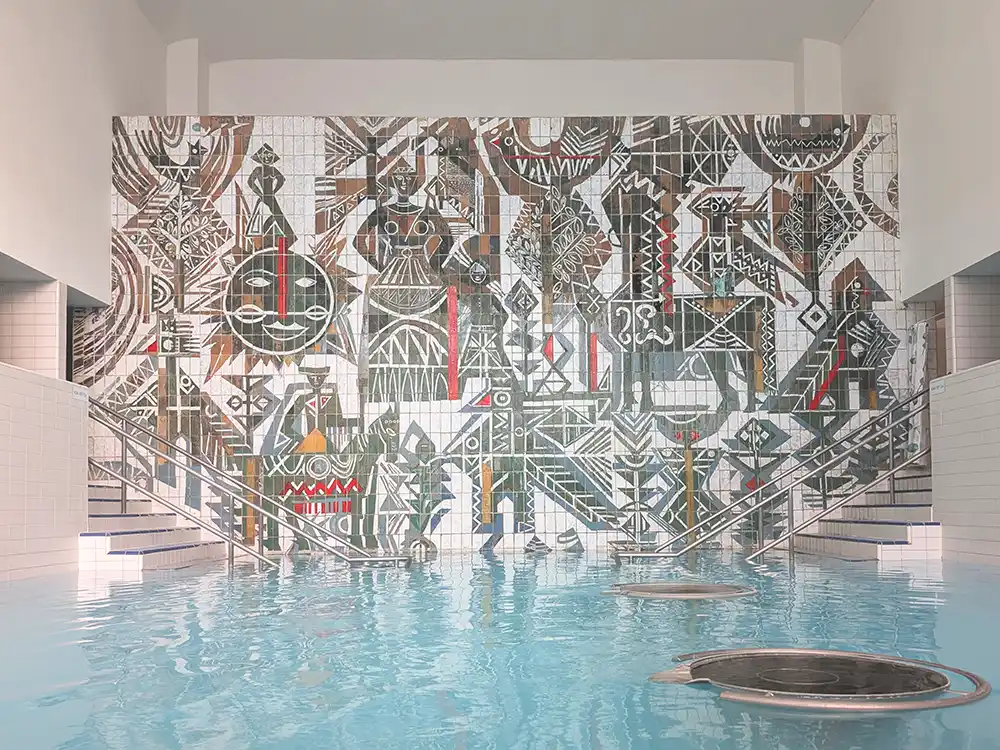
The Dr. Čapek thermal bath in the historic Manor House (Kaštieľ) is exactly how I remember classic spas from decades ago. Back in the communist era, a public soak cost 8 Czechoslovak crowns; later it crept up to 120 Slovak crowns, and over thirty years it has climbed to a neat 15 euros. Hot natural sulfur water followed by a dry blanket wrap. Oh, how good that feels.
Methuselah and Forgotten Chess
Today I spotted an older guy wearing a T-shirt that read Born 1968. Good Lord, I was already in primary school by then! I am as old as Methuselah. Old, yes, though aesthetically still clinging to a shred of youth.
The common room here has been completely conquered by sports broadcasts and social media. One lonely gentleman is staring at the Prime Minister on TV, a few bicycles are parked in the corner, and everyone else is glued to their smartphone screens. Packing that chess set from home was clearly a waste of luggage space.
Wafer Nostalgia and a Mobile Listening Room
Want to buy authentic, freshly baked spa wafers (kúpeľné oblátky)? Show up right after 10:00 AM. By evening, they are hopelessly sold out. They have chocolate, nougat, stracciatella, salted caramel, and vanilla—yet not a single trace of the classic roasted hazelnut ones. Which is a shame. Not every upgrade is an improvement. Thank goodness there’s a tiny bakery two doors down still making them the old-fashioned way.
Tonight, I’m firing up George Crumb’s Makrokosmos in my portable smartphone listening room. It sounds marginally better than the shivering street musician grinding out cheesy pop covers outside the Krym hotel.
The Moorish Hammam, Sina, and Checking Your Strings
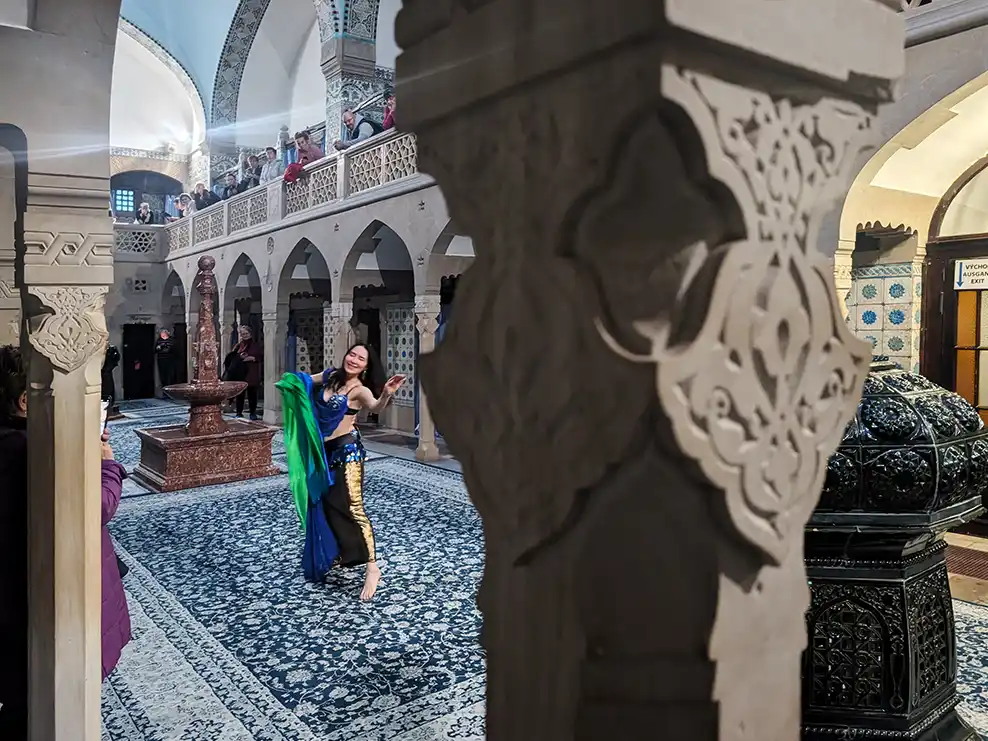
The Hammam is arguably Trenčianske Teplice’s biggest showstopper—a stunning 19th-century Moorish-style bathhouse built by an Egyptian viceroy’s daughter. Every Tuesday at 3:30 PM, they run paid guided tours. For a 5-euro ticket, you get a tape-recorded history lesson, crowds of tourists constantly blocking your view for selfies, and a ten-minute routine by a local belly dancer.
If you actually want a good photo and a moment to breathe, you need patience. Hang back for five minutes after the tour officially ends until the crowd clears out. That’s your moment. You can finally soak up the genius loci of this extraordinary space—which is an authentic Arab hammam, yet somehow isn’t, since the adjoining Sina thermal pool has zero architectural connection to it. However, if you book a medical treatment here, after twenty minutes in the genuinely hot water of the Sina pool (pushing $40\ ^\circ\text{C}$ / $104\ ^\circ\text{F}$), you get to rest right inside that magnificent Moorish hall. Either way, it’s a must-see.
A quick technical note: The Sina and Čapek thermal pools are true treasures of Trenčianske Teplice. However, stepping into a communal thermal pool wearing a standard spa loincloth missing one of its tie-strings can lead to serious complications. Especially in a co-ed pool. Double-check that you have both strings intact.
An Efficient Pacoš and Aqua-Gymnastics
Right after breakfast, we have water exercises—thank heavens the thermal pool is so warm.
Today, an elderly lady tried to help me pull plastic shoe covers over my sneakers. Excuse me?! Not happening. Do I really look that old, helpless, or—God forbid—fat?
Exercising in the water is remarkably similar to the routines on the physio table back home, only vertical and submerged. You have to stay sharp so you don’t accidentally kick the person in front of you in the backside. The leg-spreading drills also caught me off guard. Suddenly, I understand why some women turn down sex. Rotating my legs also served as a sharp reminder that I’ll probably be heading back to the hospital sooner or later. Alas, the other hip is starting to speak up too.
The daily schedule is whipping me into shape. I am evolving into a hyper-efficient spa patient: no socks required—linen trousers, a T-shirt, a beanie, and a jacket are plenty. Everything is close by; everything is within reach.
A remarkably charming cleaning lady asked me while emptying my bin if I needed anything. Nothing came to mind except a properly chilled 12-degree Bernard lager. She informed me she could assist with many things, though sadly not that.
Free Advice and Halloween Smiles
The nun and our other tablemate keep showering me with helpful life advice: we must learn to rest, we shouldn’t eat sweets, we ought to move more… Well, she’s right—in that broad, universal sense. Yesterday I was tempted to bring my tablet to lunch and show her she needn’t lecture me on fitness; I probably know a thing or two more about endurance than most. Then I dropped the idea. Should I really brag about how many thousands of kilometers I’ve cycled, how many marathons I’ve run, or how much weight I’ve lost? Who cares?
Listening around the dining tables, I realized everyone just broadcasts their own monologue. Everyone has their own truth, and most people simply need to vent. If you chime in, the other person nods politely and carries right on. They aren’t actually listening. So, take note:
- You must keep moving.
- Eating grated carrots is healthy.
- Smuggling food out of the dining hall is forbidden.
- And you must learn how to rest.
And honestly, day by day, I’m starting to care less and less about the outside world. There is a strange comfort in not wondering whether a client wants something, which phone scammer is trying to rip you off next, or whether you’ve published a new post on the website. Who cares…
Yesterday I had a long phone chat with Šiška, my six-year-old granddaughter. She has already lost four front teeth, giving her a grin straight out of Halloween. It’s adorable.
The Hardworking Beaver and the Ifigénia Spring
The only creature in Trenčianske Teplice that isn’t lazy is the beaver. Aside from a few ducks, he’s the only wildlife I’ve spotted around the swan pond. He is so relentlessly industrious, however, that by next year there probably won’t be a single tree left standing around the lake.
Learning to drink water. Relying solely on breakfast beverages will test your hydration. Tap water here isn’t particularly tasty, and sodas or pub beers are off-limits due to calories, yet a man must hydrate. That disciplined routine with a plastic cup by the bathroom sink eventually wears you down and teaches you proper hydration habits. Which is all for the best.
By the next day, my hydration strategy is permanently solved. Right outside my sanatorium stands the Ifigénia mineral spring. Apparently, it is remarkably beneficial for people suffering from digestive tract disorders, diabetes, functional bowel issues, and metabolic disorders. The water also helps with fatty liver, bile production issues, gout, urinary tract infections, and osteoporosis. Did I miss anything? Pretty much every single one applies to an old geezer like me.
The Know-It-All in the Jacuzzi
I’m enjoying the blissful quiet of the jacuzzi at the Grand hotel when a family climbs in next to me. The patriarch, clearly of advanced years and sporting a shock of white hair, is overflowing with wisdom. Impossible not to overhear. Every second sentence starts with the word “I.” I catch snippets: “Don’t even bother traveling there, I know the place, I’ve been there—nothing but dirty, uneducated Arabs, they have nothing.”
I stay silent. In moments like these, it’s the best strategy. Should I jump in and mention that Arabs laid the very foundations of modern medicine, mathematics, astronomy, optics, chemistry, and university education? That at a time when Central Europe hadn’t even invented chamber pots and much of the continent was stumbling through the Early Middle Ages, Baghdad, Damascus, Cairo, and Córdoba were home to the world’s most advanced scientific centers, libraries, hospitals, and academies?
Pointless. Instead, I quietly placed mental bets on what brand logo he’d be wearing once he got dressed. Gant? Camp David? I guessed wrong. He pulled on a jacket emblazoned with a massive, colorful Maserati Diablo crest—and climbed into a humble Škoda Fabia.
Spa Time Relativity and Oxygen Therapy
The single most important piece of equipment during spa rehabilitation is a wristwatch. Breakfast, lunch, and dinner happen on the dot, and you must show up five minutes early for every treatment. Yet time here behaves anomalously. It doesn’t flow at a constant speed. It is astonishing how fast twenty minutes vanish in the Sina and Čapek thermal pools, and how agonizingly slow twenty minutes drag on a stationary exercise bike.
Oxygen therapy presents its own special challenge. The first time I went, they stuck two plastic tubes up my nostrils and sat me in an armchair. Sit and breathe for an hour. Time crawled endlessly. I envied the seasoned “oxygen-patients” who had the foresight to bring a book.
The second time, I came prepared. I packed a book, my smartphone, and headphones. They wouldn’t break me. Literature or an audiobook? They hooked up the tubes, sat me in the armchair, I opened my book, and…
They woke me up an hour later: “Time to get up, session’s over.”