When my insurer handed me a list of post-op medical spas after my hip replacement, I faced dozens of towns all claiming “miracle” water. As a practical guy with a brand-new iron hip, I cared about one thing: which puddle would actually loosen my stiff back and joint? Thermal Water in Trenčianske Teplice won.
Once you spend twenty minutes a day soaking up to your neck in hot water, you start wondering what you’re actually marinating in. It isn’t Slovakia’s hottest or saltiest water—its secret lies elsewhere.
Why It Smells Like Rotten Eggs
Spa brochures love mixing up sulfur water, sulfates, and hydrogen sulfide. Chemically, they are distinct:
- Sulfates (1,380 mg/l): Dissolved minerals forming the water’s mineral base.
- Hydrogen sulfide (H2S— 3.74 mg/l): The dissolved gas responsible for that unmistakable rotten-egg aroma.
This gas is the real therapeutic workhorse. Absorbed through the skin, it dilates blood vessels, calms chronic inflammation, and eases joint pain. It won’t regrow worn-out cartilage, yet combined with heat and buoyancy, it melts muscle tension so a healing hip can move without pain.
What’s Inside the Trencianske Teplice Springs?
This isn’t salty seawater. Alongside sulfates and H2S, the profile rests on calcium (475 mg/l), magnesium (110 mg/l), plus elevated fluoride and strontium.
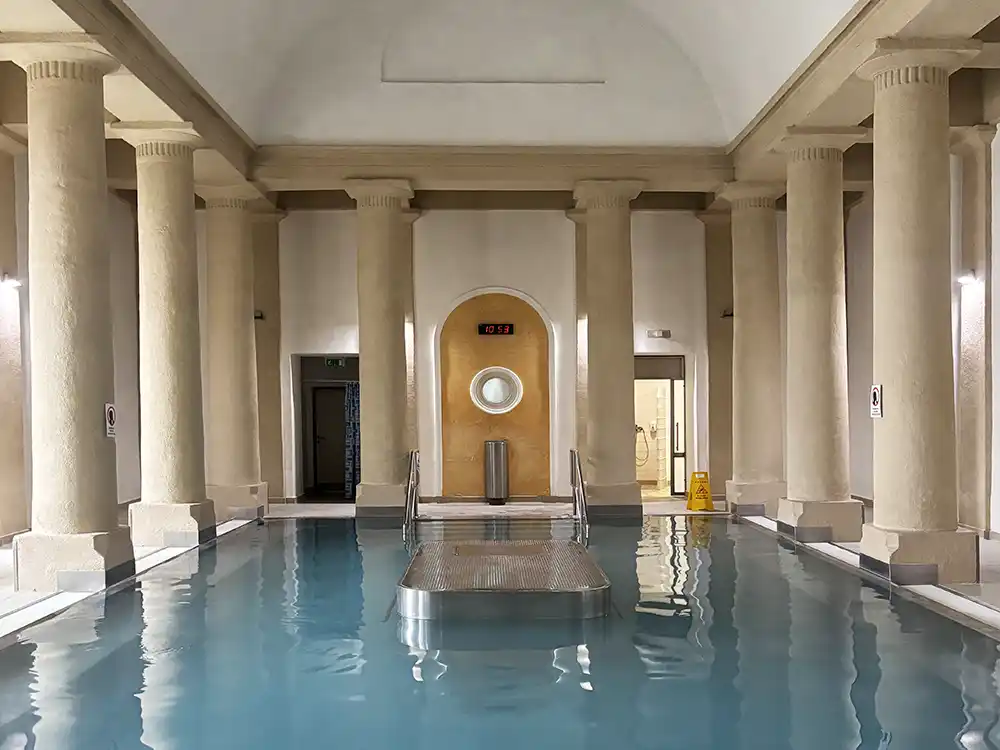
Trencianske Teplice’s biggest trump card is its natural temperature. Six springs emerge directly from the earth at 38.4 – 40 °C (101 – 104 °F). Because hydrogen sulfide is volatile and escapes if water is pumped, diluted, or cooled, this ideal natural heat means the water requires zero tampering. In the historic Sina and Čapek mirror pools, you sit right atop the spring.
Slovak Spa Comparison – Thermal Water
Comparing Slovak spas is like comparing a carbon road bike, a gravel rig, and an e-bike—each is built for different terrain:
- Piešťany (Sulfur + Mud): Teplice’s closest cousin (1,500 mg/l minerals, 4.7 mg/l H2S. It emerges at 67 – 69°C (153 – 156 °F), requiring cooling, and pairs its water with world-famous matured Váh River sulfur mud.
- Dudince (Sulfur + Sparkling CO2: Packs even more H2S (5.66 mg/l), heavy mineralization (5,500 mg/l), and 1,350 mg/l of carbon dioxide. Cooler 27°C, treating joints and heart health simultaneously.
- Bojnice (Warm & Mild): Hot boreholes (45°C / 113 °F) with low mineralization (700 mg/l) and no H2S. Heat, calcium, and magnesium do the work here.
- Chalmová (The Quiet Neighbor): Chemically similar to Teplice (1,370mg/l), calcium-magnesium-sulfate, 40.8°C, minus the rotten-egg H2S punch.
- Podhájska & Poľný Kesov (Deep Saltwater): Extreme salty brines (18,000 –19,000 mg/l in Podhájska; 1,710 m deep well in Kesov) rich in sodium, iodine, and bromine—geared toward skin and lungs rather than sulfur joint rehab.
- Sliač & Kováčová (Kings of CO2): Sliač offers nearly pure natural CO2 spring gas for circulation; Kováčová combines hot calcium-magnesium water (49°C / 120°F) with 800 mg/l CO2.
- Bardejovské Kúpele (For Your Glass, Not Your Tub): Cold, iron-rich sparkling mineral waters meant for drinking cures and inhalations targeting digestion and airways.
The Verdict
Trenčianske Teplice doesn’t hold Slovakia’s highest mineral count or hottest springs. Its edge is effortless natural balance: sulfates, calcium, magnesium, and active H2S delivered straight from the earth at body temperature. Paired with solid physiotherapy, procedures, price, street life, and plenty of ways to clear your head outside the pools, picking it off the insurer’s list was a bullseye.
FAQ: Slovak Spa Comparison Which Spa Fits Which Condition?
Sulfur-water specialists Trenčianske Teplice and Piešťany are the gold standard, with Bojnice, Kováčová, and Turčianske Teplice as solid alternatives.v
Sliač and Dudince, thanks to high natural carbon dioxide (CO2) levels that improve circulation. Dudince treats both blood vessels and joints at once.
High-altitude climatic spas in the High Tatras (Štrbské Pleso, Nový Smokovec) or Štós, plus Bardejovské Kúpele for mineral inhalations.
Bardejovské Kúpele, famous for structured drinking cures from cold, iron-rich alkaline springs.
Smrdáky (ultra-high hydrogen sulfide) and the salty thermal brine of Podhájska.
Turčianske Teplice leads for urological and kidney recovery, while Lúčky specializes in gynecological health.